Last Updated: October 26, 2026
Quick Summary
Deciding whether to repair or replace comes down to age, repair history, efficiency, and cost over time, not one quote. Most air conditioners last 10 to 15 years and furnaces 15 to 20, so a major repair on an aging unit usually tilts toward replacement. The $5,000 rule is a quick gut-check to frame the decision, not a verdict.
- Most air conditioners run 10 to 15 years, while furnaces often stretch 15 to 20.
- Three breakdowns in two years is a pattern, and patterns get expensive.
- Multiply system age by repair cost; above $5,000 flags replacement for consideration.
- A failed compressor on a teenaged unit is usually the tipping point.
- A cracked heat exchanger is a safety concern, not a repair you put off.
Table of Contents
- Repair or Replace: How to Make the Call
- HVAC System Lifespan: How Old Is Too Old?
- HVAC System Replacement Signs You Should Not Ignore
- HVAC Repair or Replacement Cost: What Actually Goes Into the Math
- The HVAC $5,000 Rule, Explained Without the Hype
- System-Specific Guidance: Heat Pumps, Furnaces, and Package Units
- Getting a Second Opinion and a Straight Diagnosis
- Sizing, Ductwork, and Installation Quality: The Part That Decides Your Savings
- Frequently Asked Questions
Repair or Replace: How to Make the Call
Your air conditioner picks the hottest week of the year to act up. Suddenly you're staring at a service quote and a decision that feels a lot bigger than a broken part. Should you repair or replace? That's the question homeowners face, and the honest answer is that hvac system repair vs replacement isn't about one number. It's about age, repair history, efficiency, and what you want the next five summers to feel like.
Here's the good news: you don't need a crystal ball. You need a few clear rules of thumb. Below, we'll walk through system lifespan, the warning signs, the real math behind cost, the $5,000 rule, and the system-specific details that change the answer. By the end, you'll know which way to lean.
HVAC System Lifespan: How Old Is Too Old?
HVAC system lifespan is the number of years a unit reliably heats and cools before repairs and efficiency losses outweigh the cost of keeping it. Most air conditioners run 10 to 15 years, while furnaces often stretch 15 to 20. Past those ranges, parts get scarce and efficiency quietly slips.
Age alone doesn't condemn a system. A well-maintained 14-year-old unit can still have life in it. But once you're in the upper teens and staring at a major repair, the math starts tilting toward replacement.
What Age Means for an Air Conditioner vs. a Furnace
An air conditioner works harder here than almost anywhere. Long cooling seasons wear out compressors faster, so a 12-year-old AC can be closer to the end than a 12-year-old furnace. Furnaces run fewer hours, so they often age more gracefully.
Here's the short version of how long each system tends to last before repairs and efficiency losses start winning.
- Air conditioner: Typical lifespan: 10 to 15 years; Note: Long cooling seasons wear out compressors faster
- Furnace: Typical lifespan: 15 to 20 years; Note: Runs fewer hours, so it often ages more gracefully
- Well-maintained unit: Typical lifespan: Can still have life at 14 years; Note: Age alone doesn't condemn a system
- Upper teens plus major repair: Typical lifespan: Math tilts toward replacement; Note: Parts get scarce and efficiency quietly slips
HVAC System Replacement Signs You Should Not Ignore
Some HVAC system replacement signs are loud, and some whisper. The loud ones: a compressor failure on an aging unit, a cracked heat exchanger, or refrigerant leaks that keep coming back. The whispers matter just as much: rising energy bills, rooms that never quite cool, and a system that needs a repair visit every season.
Frequent repairs are the tell. One breakdown is bad luck. Three in two years is a pattern, and patterns get expensive. If your unit is older, noisy, and always on the verge of something, that's your sign.
HVAC Repair or Replacement Cost: What Actually Goes Into the Math
Most homeowners compare one repair quote to one replacement quote and call it a day. That's the wrong comparison. The real question is what each option costs you over the next several years, including operating costs and energy bills.
Repair keeps your upfront cost low but leaves you with the same aging, less efficient equipment. For real numbers on what a new system costs, see our HVAC new system cost guide. Replacement costs more today but resets the clock on efficiency, reliability, and warranty coverage. A newer system often runs more efficiently than an old one, which shows up on your monthly bill. That's short-term savings versus long-term savings, and the gap widens the longer you keep an ailing unit.
The Whole-Life Cost Comparison Most Homeowners Miss
Add it up honestly: the repair you're facing now, plus the likely repairs over the next few years, plus the extra energy an aging system burns, minus the efficiency a new unit would give back. That total is the number that matters. Most folks only look at line one.
The HVAC $5,000 Rule, Explained Without the Hype
The HVAC $5,000 rule is a quick gut-check, not gospel. The idea, popularized in manufacturer guidance like Lennox's repair vs. replace guide, is to multiply your system's age by the cost of the repair. If that number lands above $5,000, replacement deserves a serious look.
Run it: a 12-year-old system facing a $500 repair scores 6,000, which flags replacement for consideration. A 6-year-old system with the same $500 repair scores 3,000, which points toward fixing it. It's a conversation starter, not a verdict. Use it to frame the talk, then let a real diagnosis decide.
System-Specific Guidance: Heat Pumps, Furnaces, and Package Units
Different equipment fails in different ways, so the repair-or-replace call shifts with the system. A blanket rule of thumb is a starting point, not an answer. Here's how the math changes by equipment type.
Air conditioners. The compressor is the heart of the system and the most expensive single component to replace. A failed compressor on a unit that's already in its teens is usually the tipping point, you're putting a major part into a system that's near the end of its expected life. A bad capacitor, contactor, or blower motor on the same unit is a different story. Those are modest repairs that can buy real time. The question to ask: is this a heart transplant or a tune-up?
Furnaces. Furnaces typically last longer than air conditioners because they run fewer hours, but they carry a safety dimension ACs don't. A cracked heat exchanger is not a maybe, it's a safety concern, and it changes the conversation immediately. Beyond that, the same logic applies: a blower motor or igniter on a 10-year-old furnace is a reasonable fix; a failed heat exchanger on a 20-year-old furnace usually points toward replacement. Ask your technician to show you what they found and explain why it matters. If replacement is the call, you can head straight to furnace installation and replacement.
Heat pumps. Heat pumps work year-round, which means more running hours and more wear on the reversing valve and compressor. A reversing valve issue is a bigger deal than a bad capacitor, and on an aging system it can push you toward replacement. Heat pumps also have a refrigerant consideration, if the system uses an older refrigerant that's being phased down, future repairs can get more expensive and less available. When you're ready, you can book heat pump repair or installation with a team that handles your specific equipment. That's worth asking about before you commit to a major repair.
Package units. Everything lives in one cabinet, compressor, coils, blower, and often the heat section. That's convenient until a major component fails, because the whole unit is one integrated system. A major failure on an aging package unit often tips toward replacement faster than a split system would, simply because you're not replacing one piece of a larger puzzle.
Dual-fuel and hybrid setups. These pair a heat pump with a gas furnace for backup. When one side fails, the decision gets more layered, you're weighing the age and condition of both halves, not just the part that broke. A technician should assess both before recommending a path.
Watch Out
A cracked heat exchanger on a furnace is not a repair you put off. It's a safety concern, and it changes the conversation immediately. If your technician flags one, treat it as urgent.
Getting a Second Opinion and a Straight Diagnosis
A diagnosis is only as good as the person giving it. Before you commit to a big repair or a full replacement, get a second opinion, especially if the first quote came with pressure and a same-day discount. A straight diagnosis walks you through what failed, why, and what the realistic options are, without the hard sell.
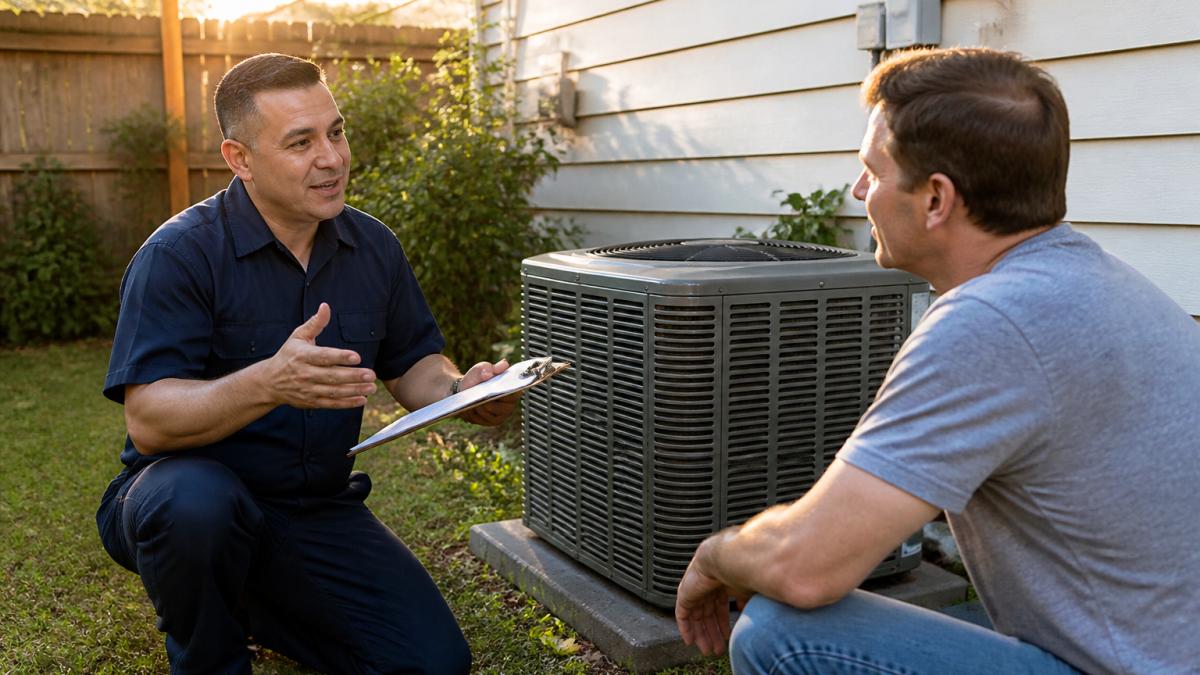
At Tommy Cool, we've been keeping folks comfortable since 1994, and we'd rather tell you to repair a system that's got life left than sell you one you don't need. That's the whole point of honest, transparent pricing. Our certified contractors diagnose first and recommend second. If you want a straight answer instead of a sales pitch, the DOE's guidance on home cooling efficiency is a good primer on what efficiency gains are realistic.
Sizing, Ductwork, and Installation Quality: The Part That Decides Your Savings
Here's what most guides skip: a replacement only pays off if it's sized and installed correctly. An oversized unit short-cycles, an undersized one runs itself ragged, and leaky ducts can waste the efficiency you just paid for. The equipment matters, but the installation decides your real savings.
Frequently Asked Questions
How do I know whether to repair or replace my HVAC system?
Start with three numbers: the system's age, the repair estimate, and how often it has broken down. A young system with an isolated, lower-cost issue is usually a repair candidate. An older unit facing a major component failure, or one that has needed repeated repairs, often points toward replacement. An inspection gives you the actual condition of the equipment, which matters more than any single rule of thumb.
What is the $5,000 rule for HVAC repair or replacement?
The $5,000 rule multiplies the unit's age by the cost of the repair. If the result tops $5,000, replacement is worth serious consideration. A 12-year-old system facing a $500 repair lands at $6,000, which flags it for a closer look. It is a conversation starter, not a verdict, so pair it with the system's overall condition and repair history before you decide.
How many years does an HVAC system usually last?
Once a system gets older, weigh each repair against how much service life is realistically left.
Is it worth repairing an HVAC system that is more than 10 years old?
Age alone does not decide it; the repair type and history do.
Can replacing an HVAC system lower energy bills?
The actual savings depend on your current equipment, your home's insulation and ductwork, and how a new system is installed. Treat any savings figure as an estimate rather than a guarantee.
Should I replace my furnace and air conditioner at the same time?
If both units are the same age and approaching the end of their service life, replacing them together often makes sense. You avoid a second installation visit, and a matched system is designed to work as a pair. If one unit is clearly younger and in good shape, a single replacement can still work, but have the technician confirm the two are compatible.
The decision between repair and replace comes down to age, repair history, efficiency, and whether the math favors one more fix or a fresh start. When you're ready for a straight diagnosis and a recommendation that puts your comfort first, get started with Tommy Cool. Our team offers 24/7 emergency service, honest pricing, and certified contractors who'll help you decide with confidence, not pressure. Be Coool.
Be Cool Today
 Add tommycool.com as a preferred source on Google →