Your air conditioner is running, but the room temperature is stuck above the thermostat setting. If your AC is not reaching thermostat setting, the reason may be added heat, restricted airflow, a control issue, or a cooling-system fault. Here is how to sort through the clues safely.
Request AC service or a comfort consultation
Short answer: An air conditioner can run continuously when the home gains heat as fast as the system removes it, or when a component cannot deliver its normal cooling. Start with the thermostat, filter, vents, and heat sources. If those checks do not explain the problem, Tommy Cool Air can inspect the system and identify whether airflow, refrigerant, controls, or equipment capacity is involved.
What does it mean when the AC runs but the temperature stays high?
The thermostat measures temperature near its sensor, then asks the cooling system to run when the room is warmer than the selected setting. A long cooling cycle does not prove that the unit is broken. Very hot outdoor weather, direct sun, open doors, or a busy home can add heat faster than usual.
However, a sudden change from normal operation matters. If the system used to reach the setting in similar weather and now cannot, something may have changed. A dirty filter, blocked return, damaged duct, incorrect thermostat reading, or equipment problem can reduce delivered cooling.
Look at the pattern as well as the number. Is the temperature falling slowly, not moving at all, or rising? Does this happen in one room or throughout the house? Does the thermostat display match a separate thermometer placed nearby? These observations help narrow the possibilities without opening equipment or handling electrical parts.
Could heat gain be overwhelming the system?
Cooling demand rises when heat enters the home. In Corpus Christi and other Gulf Coast communities, strong sun, high outdoor temperatures, and humidity can make a system work for extended periods. Heat gain can increase further when blinds are open on sunny windows, exterior doors are used often, or cooking and appliances add heat.
Check whether the problem began during a heat wave or after a change in the home. A large gathering, a newly opened room, a door that does not close, or a window receiving afternoon sun can shift the load. If the temperature eventually gets closer to the setting overnight or when the sun is weaker, heat gain may be part of the picture.
Try simple, safe steps. Keep exterior doors and windows closed while cooling. Close blinds or curtains on sun-facing windows. Avoid using the oven during the hottest part of the day if practical. Do not close many supply vents to force more air into other rooms; that can interfere with system airflow.
A programmable thermostat can help manage settings when the household schedule changes. ENERGY STAR recommends efficient heating and cooling practices such as regular filter changes, yearly equipment tune-ups, smart thermostats, and sealing ducts. See its home heating and cooling guidance for more details. Massachusetts also shares summer cooling guidance that includes programmable thermostat use; local weather and comfort needs differ, so use advice that fits your home.
Could a thermostat or setting be the problem?
Before assuming the AC has failed, check that the thermostat is set to cooling and that its target is below the displayed room temperature. Make sure the fan setting is on Auto rather than On. With the fan set to On, air may continue moving between cooling cycles, which can make supply air feel less cold even when the compressor is not running.
Check the thermostat display for a low battery warning, schedule change, hold setting, or error message. A schedule can reset the target at a particular time. If the thermostat is near a sunny window, lamp, television, or heat-producing appliance, its reading may not reflect the rest of the room.
Compare its reading with a basic thermometer placed nearby, away from direct sun and supply air. A small difference is not enough by itself to prove a fault. If the thermostat shows a much warmer or cooler temperature than the surrounding area, or the equipment cycles strangely, note what you observe for the service visit.
Do not remove wiring or open the thermostat if you are unsure how it is installed. A qualified technician can check the thermostat, wiring, settings, and system response. If you are considering a control upgrade, learn about smart thermostat installation and confirm compatibility with your equipment first.

Can restricted airflow keep the house from cooling?
Yes. Air needs a clear path into the return grille, through the system, and out of the supply vents. When that path is restricted, the system may move less conditioned air through the home. Rooms can cool unevenly, cycles may lengthen, and some equipment can develop other operating problems.
Start with the filter. If it looks loaded with dust, replace it with the correct size and type for your system. Check the manufacturer's instructions or ask a technician if you are unsure. A filter that is too restrictive or installed backward can also cause trouble. Do not run the system without a filter.
Next, make sure furniture, rugs, curtains, or stored items are not covering return grilles or supply registers. Open the vents that are meant to be open. Look for a visibly disconnected or crushed duct only where it is safely accessible; do not climb into an attic or crawlspace to investigate hazardous conditions.
If one room is much warmer than the rest, a closed or blocked vent, duct leakage, insulation differences, sun exposure, or a zoning issue could be involved. A problem across the entire home may point to a central airflow or equipment concern. Tommy Cool Air offers duct cleaning and sealing services and ductwork installation and repair when inspection indicates a duct issue.
Could low refrigerant or another equipment fault be responsible?
A refrigerant leak or other cooling-system fault can reduce the system's ability to remove heat. Homeowners should not try to measure, add, or release refrigerant. It requires trained handling and appropriate diagnostic equipment. Weak airflow, ice on refrigerant lines or the indoor coil, unusual sounds, or cooling that has worsened over time are reasons to stop troubleshooting and arrange service.
Other possible causes include a dirty indoor coil, a problem with the outdoor unit, a failing electrical component, a drain-related safety interruption, or a control fault. Similar symptoms can come from different failures, so a single clue does not confirm a diagnosis. For instance, ice may follow restricted airflow or a refrigerant issue, and simply restarting the AC may make the condition return.
If you see ice, turn the cooling off at the thermostat and leave the fan setting as directed by your equipment instructions. Do not chip ice away or open the cabinet. If there is a burning odor, sparking, or a suspected electrical hazard, stop using the system and seek qualified help promptly.
For a broader explanation of safe first checks, read this guide to central air conditioning problems. If the system is not cooling or the problem is worsening, use the AC repair service page to understand the relevant service path.
How can you compare the likely causes?
Use the pattern below as a starting point, not as a diagnosis. Several issues can occur at once. A technician can confirm which one is affecting your system.
| Possible cause | Clues you may notice | Safe first check | When to arrange service |
|---|---|---|---|
| High heat gain | Problem began during hotter weather or strong afternoon sun; temperature improves later | Close doors and windows; shade sunny windows | Cooling remains inadequate in ordinary conditions or worsens |
| Thermostat or settings | Schedule changed, fan runs continuously, display warning, or reading seems inconsistent | Confirm Cool mode, target, schedule, and Auto fan setting | Controls remain inaccurate or equipment responds unpredictably |
| Filter or airflow restriction | Weak airflow, dusty filter, blocked grille, or uneven room temperatures | Replace a dirty filter correctly; clear vents and returns | Airflow remains weak, or ice appears on the equipment |
| Duct or distribution issue | One room stays warm or airflow differs noticeably between rooms | Check accessible registers and visible duct sections | Suspected leak, disconnected duct, or persistent room imbalance |
| Refrigerant or equipment fault | Cooling declined, ice or unusual sounds appear, or the outdoor unit behaves abnormally | Turn cooling off if ice or a serious warning sign appears; do not open equipment | Arrange a qualified inspection; do not handle refrigerant or wiring |
| System capacity or home changes | Problem follows an addition, remodel, new heat source, or long-term change in cooling performance | Note what changed and which rooms are affected | Ask for a load and equipment evaluation before assuming replacement is needed |
Could the air conditioner be undersized or losing capacity?
When an AC cannot keep up consistently, the system's capacity and the home's cooling load may need a closer look. An addition, changed insulation, new windows, altered duct layout, or persistent air leakage can change how much cooling the home needs. Equipment condition also matters; performance can decline when maintenance or repairs are needed.
Do not assume that a larger unit is automatically the answer. Correct sizing depends on the home, ducts, equipment, and local conditions. Oversizing can create other comfort problems, including short cycles and uneven humidity control. A professional evaluation can assess the equipment and distribution before recommending repair, adjustment, or replacement.
If the system is older or a repair decision raises broader questions, consider an evaluation rather than selecting equipment based only on the nameplate or square footage. Tommy Cool Air provides home energy-efficiency evaluations and AC installation and replacement. Individual repair and installation quotes depend on the project and system assessment.
What can you safely check before calling?
Keep the first pass simple. Do not remove equipment panels, test live wiring, or handle refrigerant. Write down the thermostat setting and room reading, then note whether the temperature changes after these checks:
- Confirm the thermostat is in Cool mode and its target is below the room temperature.
- Check whether a schedule, hold, or fan setting changed.
- Replace a dirty filter with the correct type and direction, following the equipment instructions.
- Clear furniture and other obstructions away from supply vents and return grilles.
- Close exterior doors and windows, and reduce direct sun through windows where practical.
- Look for visible ice, unusual sounds, water near equipment, or an outdoor unit that appears not to run.
- Record when the problem started, which rooms are affected, and any recent changes in the home.
If ice is present, turn off cooling rather than repeatedly restarting the system. If you notice an electrical hazard or burning smell, leave the equipment off and arrange prompt professional help. For less urgent issues, scheduled AC maintenance and tune-up service can help assess operating condition and airflow.
What should you tell an HVAC technician?
A few clear observations can help the technician focus the inspection. Share the thermostat setting and displayed room temperature, how long the system has been running, and whether the temperature is falling, flat, or rising. Mention if the issue affects every room or only part of the home.
Also note filter age and type, recent thermostat or home changes, unusual sounds, visible ice, water, or error messages. If you took a comparison temperature, say where and when you measured it. Avoid trying to diagnose the component yourself; the same symptom can have multiple causes.
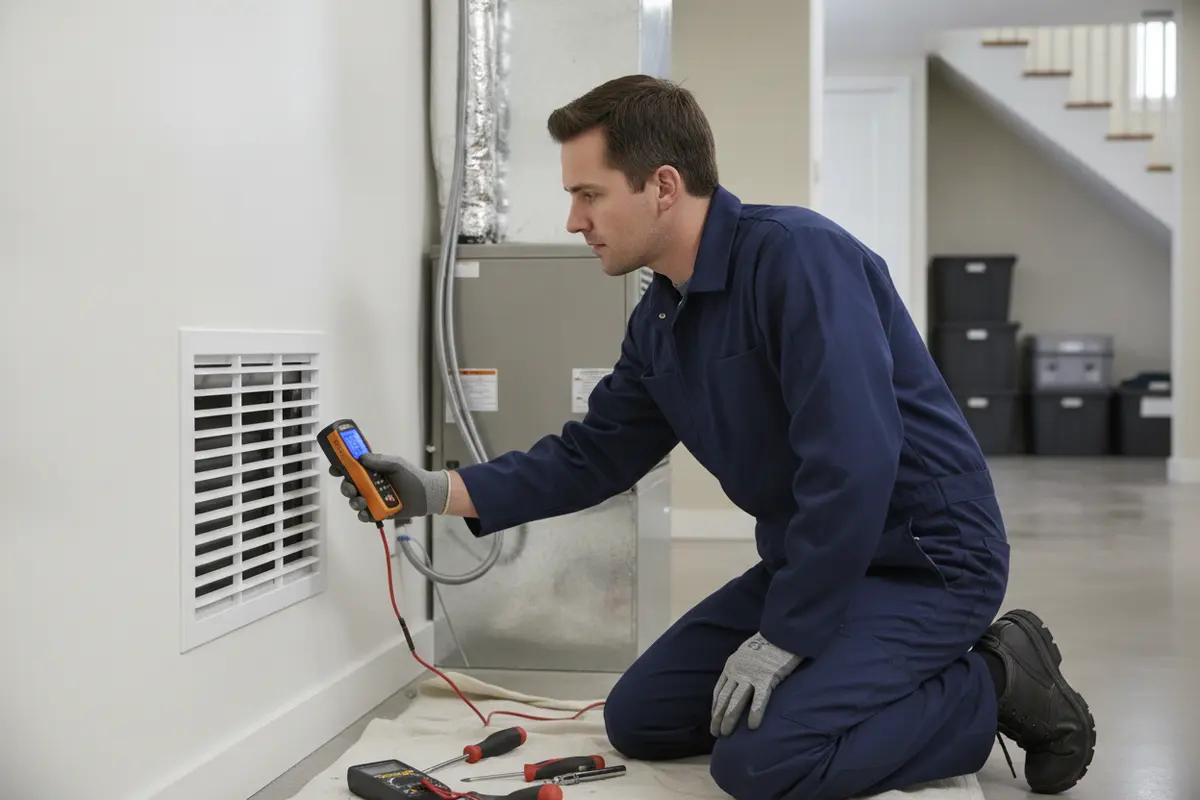
During diagnosis, a technician may check thermostat operation, filters, airflow, coils, electrical components, refrigerant conditions, condensate protections, and outdoor-unit operation. The steps depend on the symptoms and equipment. If the cause appears related to duct distribution, a home change, or system sizing, explain which rooms are affected and what has changed.
For support in the surrounding area, see Tommy Cool Air's Corpus Christi and Gulf Coast service areas. Homeowners can also review the HVAC frequently asked questions or the company's Cool Kids Comfort Club information for general program details.
When should you stop troubleshooting?
Arrange service if the system keeps running without meaningful cooling after basic checks, the problem repeatedly returns, airflow is weak, the thermostat does not control the equipment, or you see ice. Prompt attention is also appropriate for unusual noises, water near indoor equipment, or an outdoor unit that does not behave normally.
Turn the system off and seek qualified help if you smell burning, see sparks, or suspect an electrical problem. Do not touch exposed wires, open electrical compartments, or attempt refrigerant repairs. If indoor conditions become unsafe for someone in the home, move to a cooler safe place while arranging help.
For a service request or project discussion, use Tommy Cool Air's contact page. If you are comparing longer-term efficiency options, the energy-saving heating and cooling systems page outlines a related service area.
Contact Tommy Cool Air to discuss your AC concern
Frequently asked questions
Is it normal for an AC to run continuously on a very hot day?
Long cycles can happen when outdoor heat and indoor heat gain are high. If the home stays much warmer than the setting, performance has changed, or the system never makes progress in similar conditions, check the basics and arrange service if needed.
Should I keep lowering the thermostat to make the AC cool faster?
No. A much lower target does not make the equipment cool faster. Set a comfortable target and check the system's mode, filter, vents, and doors instead. If the temperature still does not move toward the setting, the cause may need diagnosis.
Can a dirty air filter stop my home from reaching the setting?
It can restrict airflow and reduce system performance. Inspect the filter and replace it if it is dirty, using the correct size and type. If airflow remains weak or ice forms, turn cooling off when ice is present and contact a professional.
Does ice on an AC mean it needs more refrigerant?
Not necessarily. Ice can be associated with airflow restrictions or a refrigerant problem, among other issues. Do not add refrigerant or chip away ice. Turn cooling off and arrange an inspection to identify the cause.
Can a thermostat reading be wrong even when the display works?
Yes. Thermostat placement, a sensor issue, or a control problem can affect how it reads or responds. Compare it with a nearby thermometer away from direct sun and supply air, and share any mismatch with a technician.
When your AC keeps running without reaching its setting, start with the simple checks and use the symptoms to guide your next step. If the cause is not clear or cooling remains inadequate, a professional inspection can identify the problem safely.