Choosing the right equipment starts with more than counting rooms. Whole home dehumidifier sizing depends on the house, the moisture entering it, and how the system will work with the existing HVAC equipment. In coastal Texas, outdoor humidity, air leakage, and everyday household moisture can all affect the load.
Request a whole-home humidity assessment
Short answer: A dehumidifier should be selected after estimating the home's moisture load, reviewing its size and layout, and checking how the equipment will connect with the HVAC system. Square footage is a starting point, not a complete sizing method. Tommy Cool Air can assess the home's humidity-control needs and discuss an appropriate system for its conditions.
Why isn't square footage enough to size a dehumidifier?
Room area gives a rough sense of how much space the equipment may serve. It does not tell you how much water vapor enters the home each day or how difficult that moisture is to remove. Two houses with similar floor area can have different needs because of their construction, air leakage, occupancy, and ventilation.
Consider two coastal homes of similar size. One may have a tight building envelope, limited outdoor-air leakage, and modest indoor moisture. The other may have frequent door openings, a humid crawlspace or attic influence, more occupants, or a ventilation setup that brings in humid outdoor air. The second home can place a greater demand on humidity control, even if the floor plans look alike.
Manufacturers often describe a dehumidifier's capacity in pints of moisture removed per day. That number helps compare equipment, but it should be read under the rating conditions specified by the manufacturer. Capacity can vary with air temperature and humidity. Comparing one product's headline number with another product's number without checking their test conditions may not be an apples-to-apples comparison.
A useful selection process therefore combines the equipment rating with an assessment of the home. The goal is not simply to buy the largest available unit. It is to find capacity and controls that suit the measured or estimated moisture load and intended operating conditions.
Think of square footage as a map of the space, not a measurement of the water the home needs to shed. A compact, shaded house with good air sealing may experience a different load from a same-size home with an open plan, frequent outside-air exchange, and several moisture-producing activities at once. The floor area helps establish the starting scope; it cannot capture those differences by itself.
What factors affect whole home dehumidifier sizing in a coastal home?
A sizing assessment should consider the house as a system. Several details can change the amount of moisture the equipment needs to handle.
- Conditioned floor area and ceiling height: These help describe the volume of indoor air the equipment serves. A home with tall ceilings or multiple connected zones may not behave like a simple, compact floor plan.
- Air leakage and envelope condition: Gaps around doors, windows, attic access, and penetrations can allow humid outdoor air to enter. The home may need envelope improvements as well as equipment, depending on what an inspection finds.
- Outdoor-air ventilation: Fresh-air systems and exhaust fans affect how air moves through the home. Ventilation is important, but bringing in humid air can add moisture that the indoor system must manage.
- Indoor moisture sources: Cooking, bathing, laundry, plants, and the number of people at home all contribute moisture. The pattern and duration of these activities matter.
- Existing air conditioning: An air conditioner can remove moisture while cooling, but its humidity performance depends on system operation, airflow, sizing, controls, and conditions. A separate dehumidifier may be considered when comfort or moisture concerns remain, but an assessment should first check the AC system.
- Room arrangement and zoning: Closed doors, additions, distant rooms, and separate zones can affect where dry air travels. A central location does not guarantee even distribution in every layout.
- Location and drainage: The installer needs a suitable place for the equipment, a path for condensate drainage, electrical access, and workable connections to ducts when the design calls for them.
Humidity measurements add useful context. A portable hygrometer can show relative humidity in a room, but one reading does not explain the cause or represent every part of the house. Measurements over time, taken in different areas and under typical operating conditions, offer a more useful picture.
For example, readings that rise mainly in a bedroom overnight can point the assessment toward room-by-room airflow, closed doors, or differences in use. High readings throughout the house during damp weather may call for a broader review of outdoor-air entry, ventilation, and cooling operation. These patterns do not diagnose a fault on their own. They help the technician decide what to inspect and where to gather more information.
It is also useful to distinguish a temporary moisture event from a persistent condition. A steamy bathroom immediately after a shower is different from a living room that feels damp for much of the day. Run bathroom exhaust fans as intended and note whether humidity settles afterward. If it does not, describe the timing and affected areas rather than assuming a larger appliance is the answer.
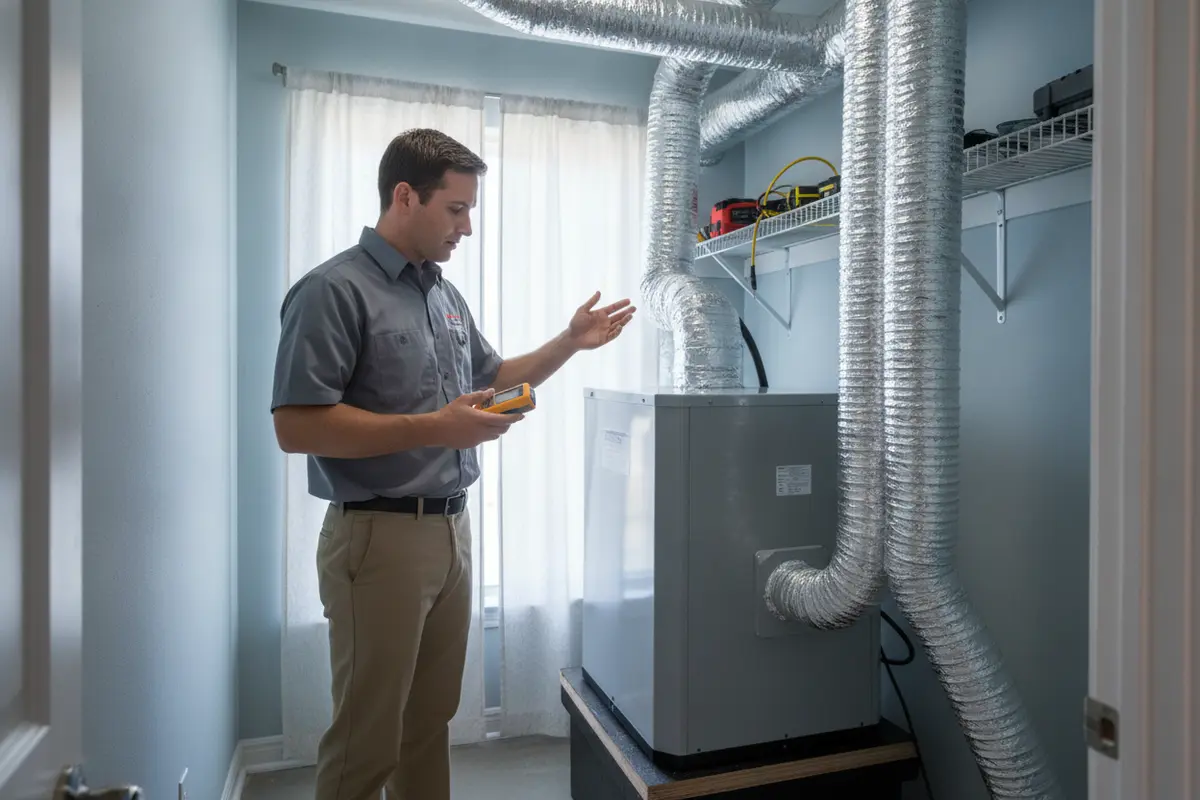
How does the dehumidifier interact with the air conditioner?
Whole-home dehumidifiers are designed to serve a house rather than a single room. Depending on the equipment and installation design, they may use dedicated return and supply ducts or connect with existing HVAC ductwork. The right arrangement depends on the home and equipment instructions.
That interaction matters because the dehumidifier, air handler, thermostat, and duct system all influence comfort and airflow. A design should clarify when each system runs, where air is drawn from, where treated air is delivered, and how the condensate is removed. Poorly planned connections can make it harder to distribute dry air or coordinate operation.
Ask whether the assessment includes a review of the existing AC equipment, controls, duct capacity, and proposed dehumidifier connections. If the AC is oversized, has airflow issues, or is not operating as intended, adding dehumidification without addressing the underlying condition may not solve the comfort problem. A technician can determine whether the priority is a repair, adjustment, humidity-control addition, or another step.
Controls are part of that coordination. Ask whether the dehumidifier will use its own humidity control, connect to a compatible thermostat, or operate through another arrangement specified for the equipment. Learn what happens when the home is already cool but still humid, and how the system is expected to respond. The answer should describe the actual proposed setup, not assume every thermostat or air handler works the same way.
Homeowners comparing system options can also review the provider's air conditioning services, AC maintenance and tune-up information, and home energy efficiency evaluation. These are useful paths when the humidity concern may be related to cooling performance or air movement.
What should the duct and installation review include?
For a ducted whole-home unit, the contractor should look beyond the appliance label. The proposed location, duct connections, airflow path, service access, and condensate disposal all affect whether the system can operate as intended.

- Air path: Confirm where the unit draws air and where it returns conditioned air. The plan should make sense for the rooms and zones the system is meant to serve.
- Duct compatibility: Review duct size, configuration, restrictions, and connections. Existing ductwork may need changes, or a dedicated duct arrangement may be more suitable.
- Condensate handling: Identify a safe, code-compliant route for collected water and any necessary protection against overflow. The exact setup depends on the equipment and site.
- Controls: Clarify how the dehumidifier senses humidity and how its operation coordinates with the HVAC system. Ask where the control will be located and what settings the homeowner can adjust.
- Maintenance access: Confirm that filters and service points can be reached without dismantling unrelated equipment or stored items.
- Operating sound and placement: Discuss whether the proposed location could transmit noise to a living or sleeping area.
Placement and duct layout should be considered together. A location near the existing air handler may simplify some connections, but it is not automatically best if the route restricts service access or fails to serve distant parts of the house. In a home with additions or closed-off rooms, ask how air will circulate between the served areas. The installer should explain the air path in everyday terms and identify any zones the proposed arrangement may not reach evenly.
Condensate planning deserves a clear explanation as well. The equipment removes moisture from air and needs a dependable way to dispose of collected water. Ask where the drain will terminate, whether the route can be inspected, and what the homeowner should watch for during normal operation. Do not assume that a convenient nearby drain is appropriate without review of the equipment instructions and site conditions.
A proposed installation should also explain what is included and what conditions might require additional work. Request a written scope that identifies the equipment, duct approach, electrical or drainage work, controls, and any assumptions. Individual installation pricing is quote-based, since the home and project requirements differ.
Tommy Cool Air's humidifier and dehumidifier service page is the relevant place to learn about humidity-control service. For broader indoor-air concerns, see the company's indoor air quality services and ventilation system information.
How do common sizing approaches compare?
There is no single shortcut that captures every home's moisture load. Use the following comparison to understand what each input can and cannot tell you. A professional assessment combines several of them rather than relying on one measurement.
| Input or approach | What it helps show | What it cannot decide alone |
|---|---|---|
| Floor area and room layout | Approximate space served and distribution challenges | Actual moisture entering the home or required capacity |
| Indoor humidity readings | Relative humidity in a location at a particular time | Why humidity is elevated or how other rooms perform |
| Moisture-source review | Potential contributions from people, activities, and outdoor air | Equipment performance or duct compatibility |
| AC and duct inspection | Cooling operation, airflow, controls, and connection options | A complete capacity choice without the home's overall load |
| Manufacturer capacity rating | Comparison of moisture removal under stated test conditions | Real-world results if the rating conditions differ from the home |
| Combined professional assessment | How load, equipment, ducts, controls, and installation fit together | A guarantee that every comfort concern has only one cause |
Use the comparison as a way to interpret a recommendation, not as a do-it-yourself sizing formula. A room reading can identify where to look. A floor plan can show which areas are connected. An equipment rating can show how models compare under a defined test. The useful decision comes from connecting those clues with the actual HVAC and installation conditions.
How can you evaluate a sizing recommendation?
A useful recommendation should make the assumptions visible. Ask what information was used to estimate the home's moisture load, whether indoor humidity was checked in more than one location, and how the recommendation accounts for outdoor-air entry. You do not need to calculate the load yourself. You do want to understand the connection between the home's conditions and the proposed equipment.
Check whether the quoted capacity is stated using the manufacturer's published rating conditions. Ask what the rating means for your home, and whether the proposal accounts for the temperature and humidity where the unit will operate. A single capacity number without context does not explain how the unit will perform in a particular installation.
Review the installation plan alongside the equipment selection. A suitable unit still depends on sound airflow, a workable drain route, appropriate controls, and accessible maintenance points. Ask the contractor to identify any assumptions about existing ductwork or electrical service, and whether those items have been inspected or are excluded from the estimate.
- Ask what rooms and zones the proposed system is intended to serve.
- Confirm where the unit will draw air from and where treated air will go.
- Ask how the humidity control will interact with the thermostat and air conditioner.
- Clarify what installation work, drainage, and controls are included in the quote.
- Discuss how to maintain the equipment and whom to contact if humidity does not improve.
These questions help you compare proposals on more than equipment capacity. They also make it easier to spot whether two quotes assume different duct work, controls, or installation conditions. If an answer is unclear, ask for the detail in writing before approving the project.
When comparing two proposals, place the equipment and the scope side by side. One may include dedicated ductwork while another assumes an existing connection; one may describe control integration while another leaves it unspecified. Those are not necessarily equivalent designs, even if both list a similar capacity. Ask each provider to identify the intended area served, the installation assumptions, and any work that would change the quote if the assumptions prove incorrect.
Also ask what follow-up would look like if the home still feels damp after installation. A complete explanation should tell you which settings are adjustable, what routine maintenance the manufacturer calls for, and which symptoms merit a service call. That conversation sets realistic expectations: the equipment addresses humidity as part of a system, while unresolved water intrusion, ventilation imbalance, or HVAC problems may need separate attention.
What should you prepare before requesting an assessment?
A few observations can make a service conversation more productive. You do not need to diagnose the system or choose a capacity before calling. Share what you have noticed and let the technician evaluate the home.
- Note when the problem occurs. Record whether rooms feel damp all day, after showers, during rainy weather, or when the AC cycles off. Include any changes by season.
- Identify affected rooms. Note whether the issue is throughout the home or concentrated in one area, such as a bedroom, addition, or lower level.
- Write down available readings. If you already own a hygrometer, note the location, time, and reading. Avoid treating one measurement as a complete diagnosis.
- Describe how the AC runs. Mention long or short cycles, unusual airflow, recent service, and whether the humidity concern continues while the system is cooling.
- List possible moisture sources. Include ventilation equipment, frequent laundry or cooking, or areas where dampness is visible. Do not disturb suspected mold or water damage.
- Gather equipment details. If convenient, note the AC model or thermostat type and take a photo of the equipment area. Do not remove panels or open electrical compartments.
A simple log is often more helpful than a long list of guesses. For several days, record the date, time, room, general weather, thermostat setting, and any humidity reading already available. Include whether the air conditioner was running and whether doors or windows were open. You do not need to create perfect measurements; consistent notes can help show whether the concern follows a pattern.
Before the visit, make the indoor equipment and thermostat accessible if it is safe to do so. Keep notes about past repairs or recurring comfort issues nearby. Avoid moving heavy equipment, opening electrical panels, or trying to inspect duct interiors yourself. The purpose is to share observations and allow a qualified professional to inspect the system safely.
For context, homeowners can review whole-home dehumidifier benefits and the company's energy-saving heating and cooling systems. Those resources help frame the conversation, but they do not replace an assessment of the specific home.
What humidity level should a homeowner discuss?
Relative humidity is a practical starting point for a conversation, but a single target should not be treated as a substitute for diagnosis. The U.S. Department of Energy's Building America Solution Center describes whole-house dehumidification options for maintaining indoor relative humidity below 60%. See its whole-house dehumidification guidance for more information.
Comfort can vary with air temperature, air movement, clothing, and personal preference. Persistent condensation, musty odors, or damp materials also deserve attention because they may indicate a moisture source or building issue, not simply a need for a larger appliance. A dehumidifier cannot correct a roof leak, water leak, drainage problem, or other source of water intrusion. Identify and address the source where appropriate.
Ask the technician what the measurement represents, where it was taken, and whether other locations should be checked. Discuss your comfort concern and the operating settings you prefer. The right system plan should explain how the unit will be controlled and what observations would prompt a follow-up adjustment.
In practical terms, bring up both the number and the experience behind it. A reading taken in a hallway may not reflect a closed bedroom, and a brief reading after a shower may not describe normal conditions. Ask whether measurements were collected while the AC was operating normally and whether other parts of the home show a similar pattern. This keeps the discussion focused on the conditions the system is expected to manage.
When should you consider professional sizing help?
Professional guidance is useful when humidity remains uncomfortable despite normal AC operation, when a portable unit cannot serve the areas you need, or when you are considering a ducted system. It is also worthwhile if the home has uneven humidity, a complex floor plan, recent additions, or questions about how new equipment connects to existing ducts.
Do not select a system based only on an online square-footage chart or a salesperson's suggestion to choose the largest capacity. Ask for the reasoning behind the recommendation. A clear explanation should connect the home's size and moisture conditions to equipment capacity, duct approach, controls, drainage, and maintenance access.
For a project estimate, use the contact page to request a consultation. If you are comparing service options, the company's HVAC frequently asked questions and Corpus Christi service-area information may also help. Tommy Cool Air serves homeowners in Corpus Christi and surrounding Gulf Coast communities.
Talk with Tommy Cool Air about humidity control
Frequently asked questions
Can I size a whole-home dehumidifier by square footage alone?
No. Floor area is a useful starting point, but moisture sources, air leakage, ventilation, HVAC performance, duct layout, and manufacturer rating conditions also affect the selection.
Does a larger dehumidifier always work better?
Not necessarily. The equipment should match the home's moisture load and system design. Capacity alone does not resolve airflow, controls, duct, or moisture-source problems.
Can an air conditioner replace a whole-home dehumidifier?
An air conditioner removes some moisture while cooling, but results depend on operating conditions, sizing, airflow, and controls. An assessment can determine whether the AC needs attention or separate humidity control is appropriate.
What should an installer check before recommending a unit?
The review should consider the home and moisture sources, indoor humidity observations, AC operation, duct connections, controls, drainage, equipment placement, and service access.
Get a sizing recommendation based on your home
Whole-home dehumidifier sizing is a home-specific decision, especially in a coastal climate where outdoor humidity and building conditions can change the moisture load. A measured review of the house, HVAC equipment, and installation options gives you a clearer basis for choosing a system. Tommy Cool Air can help you discuss the next step for your home.